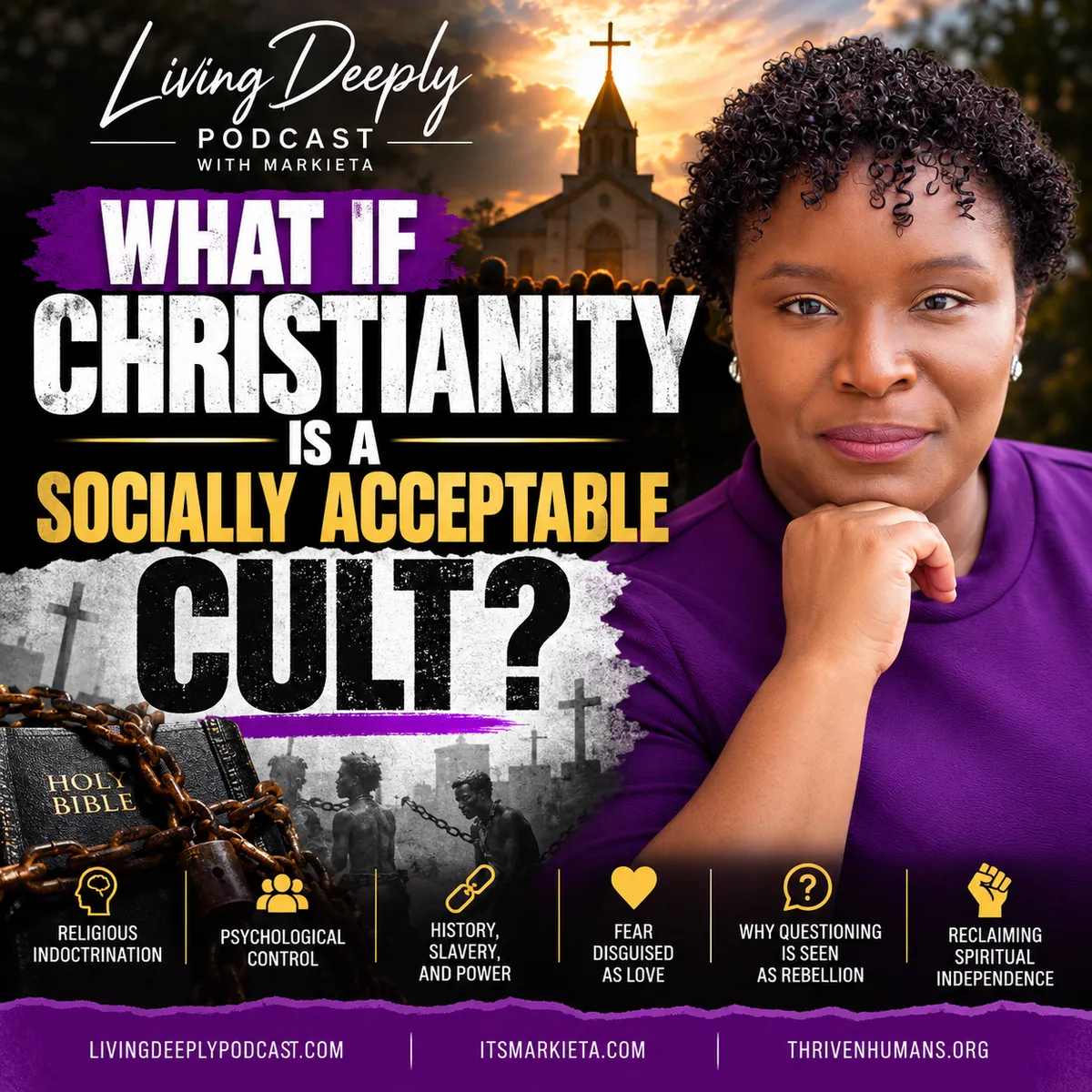
What If Christianity Is a Socially Acceptable Cult?
What if Christianity is one of the most socially acceptable cult-like religious systems in the world?
I know. That's a question that will make some people uncomfortable. It may even offend a few people. But discomfort doesn't automatically make a question inappropriate, and being offended doesn't make an argument incorrect.
As a Black woman who grew up in the South, Christianity wasn't presented to me as one religious option among many. It was presented as the only acceptable truth.
You believed in God, Jesus, and the Bible, or you were going to hell.
Anything outside of Christianity was considered sinful, demonic, dangerous, or spiritually misguided. Questioning what you were taught could get you labeled rebellious, disrespectful, lost, or even mentally unstable.
For years, I accepted much of what I was taught because it was all I knew.
But as I became more educated, developed my own worldview, and began exploring spirituality outside of Christianity, I started questioning something that society rarely encourages us to examine.
Why do we recognize certain behaviors as cult-like in smaller religious organizations but normalize those same behaviors when they occur within Christianity?
I'm not writing this article to convince anyone to abandon Christianity. I'm not interested in converting anyone to my spiritual beliefs, either.
I'm interested in examining religious indoctrination, psychological control, historical oppression, and the importance of intellectual and spiritual independence.
And I believe Christianity, like every other belief system, should be open to scrutiny.
What Actually Makes Something a Cult?
The word cult tends to provoke an immediate emotional reaction.
People often imagine isolated communities, charismatic leaders, unusual rituals, or groups that demand absolute loyalty.
But the more important issue isn't whether a religion is unusual or unpopular.
It's how much control an organization exercises over its members.
Scholars don't use one universally accepted definition of a cult. In discussions about coercive organizations, terms such as high-control group can be more useful.
High-control environments may discourage questioning, use fear to enforce obedience, isolate members from outside perspectives, punish people for leaving, or claim authority over their personal decisions.
Now consider some Christian environments.
What happens when someone questions a pastor's teachings?
What happens when a woman refuses to submit to her husband?
What happens when someone identifies as LGBTQ+?
What happens when an adult child announces that they no longer believe in Christianity?
In some families and churches, the consequences can include rejection, shame, threats of divine punishment, and the loss of important relationships.
Not every Christian community operates this way. Many welcome questions and respect personal autonomy.
But when these controlling behaviors occur, why should Christianity's social acceptance protect them from criticism?
Religious Indoctrination Often Begins Before We Can Think Critically
Most people don't begin their religious lives by independently researching Christianity, Islam, Buddhism, Hinduism, African traditional religions, and secular philosophies before deciding which worldview makes the most sense.
Many inherit the religion of their parents.
They are introduced to religious teachings before they can read, reason critically, or understand the implications of what they're being told.
They're taught to pray.
They're taught about heaven and hell.
They're taught what God supposedly approves and disapproves of.
And in some Christian environments, they're taught that questioning those beliefs could have eternal consequences.
I believe there's an important distinction between teaching children about religion and teaching them to fear independent thought.
Parents have every right to share their values and beliefs with their children.
But children should eventually have the freedom to examine those beliefs without threats, shame, or rejection.
Imagine growing up believing that an invisible authority knows every thought you have and that questioning the wrong thing could result in eternal punishment.
For some people, those teachings become deeply rooted fears that persist well into adulthood.
And when they begin questioning Christianity, they're not simply evaluating religious claims.
They're confronting years of emotional conditioning.
I eventually had to ask myself:
Do I actually believe this because I've examined it and found it convincing, or because I was taught to fear the consequences of not believing?
That question changed how I approached religion.
Christianity, Slavery, and the Religious Conditioning of Black Americans
As a Black woman, I find Christianity's historical relationship with slavery particularly important.
Christianity existed in Africa long before European colonization and the transatlantic slave trade. Ancient African Christian traditions have rich histories, and Christianity also inspired abolitionists and Black freedom movements.
But we cannot ignore the fact that Christianity was also used to justify slavery, reinforce racial hierarchies, and encourage obedience among enslaved people.
Enslavers selectively interpreted biblical passages to support human bondage.
Some emphasized scriptures instructing servants to obey their masters.
Others restricted access to religious education or emphasized teachings that discouraged resistance.
One historical example is Select Parts of the Holy Bible for the Use of the Negro Slaves, in the British West-India Islands, published in 1807.
Often called the Slave Bible, it excluded substantial portions of biblical scripture, including major narratives of liberation.
That history demonstrates how religious teachings could be selectively presented to support systems of oppression.
And yet, generations later, questioning Christianity can still be treated as unacceptable in some Black families.
I find that contradiction worth examining.
Our ancestors had diverse spiritual traditions, cultural identities, and relationships with the sacred long before European colonization.
They were not spiritually empty people waiting for Christianity to give their lives meaning.
And I refuse to believe that honoring my ancestors requires me to accept Christianity as the only legitimate path.
For me, honoring my ancestors includes exercising the intellectual freedom that so many of them were denied.
It means having the courage to question inherited beliefs, examine history, and determine what I believe for myself.
When Fear Is Disguised as Love
One of the most difficult aspects of Christianity for me was reconciling the idea of unconditional divine love with the threat of eternal punishment.
I was taught that God loved everyone.
That God was merciful.
That God was compassionate.
But I was also taught that rejecting God could result in eternal suffering.
Those messages never made sense to me together.
Imagine someone in a romantic relationship saying:
"I love you unconditionally, but if you don't love me back, I'll punish you forever."
Most of us would recognize that as a deeply concerning relationship dynamic.
Yet certain Christian traditions present eternal punishment as compatible with divine love.
Of course, Christians have different interpretations of hell, salvation, and divine judgment. Not all believe in eternal conscious torment.
But the Christianity I experienced relied heavily on fear.
Fear of hell.
Fear of disappointing God.
Fear of questioning scripture.
Fear of spiritual deception.
And I eventually realized that I didn't want fear to determine my worldview.
If someone maintains a religious belief primarily because they're terrified of what might happen if they leave, I believe it's worth asking whether that belief is truly being held freely.
When Questioning Religion Becomes Rebellion
One of the most troubling characteristics of high-control religious environments is their response to independent thinking.
Ask why women should submit to men, and someone may accuse you of rejecting God's design.
Question religious teachings about LGBTQ+ people, and someone may accuse you of being influenced by Satan.
Challenge the idea that people should remain in unhealthy marriages, and someone may tell you that you're rejecting biblical authority.
Decide that Christianity no longer aligns with your worldview, and suddenly people who previously respected your intelligence may begin questioning your judgment.
Some will call you rebellious.
Some will call you lost.
Some will say you need deliverance.
And some may even attack your mental health.
Let me make something clear.
Religious disagreement is not evidence of mental illness.
Choosing to be nonreligious doesn't make someone mentally unstable.
Exploring meditation, chakras, ancestor traditions, or other spiritual frameworks isn't, by itself, evidence of a psychiatric condition.
And setting boundaries with religious family members doesn't mean someone is incapable of making sound decisions.
Mental health terminology should never be weaponized against people simply because they refuse to conform to someone else's religious expectations.
I don't need anyone to diagnose my spiritual independence.
And I certainly don't need anyone's permission to evolve.
Religious Manipulation in Marriage and Family Relationships
I've personally experienced how religion can be used to manipulate people within relationships, including my former marriage.
And something I've learned is that religious manipulation isn't always intentional.
Sometimes people are repeating what they were taught.
Sometimes they genuinely believe they're protecting someone.
Sometimes they believe they're speaking on behalf of God.
But intentions don't automatically eliminate harm.
When someone uses scripture to pressure a woman into remaining in an unhealthy relationship, religion can become a mechanism of control.
When family members believe their religious convictions give them authority over another adult's personal decisions, boundaries can become difficult to maintain.
When someone uses God's name to invalidate your feelings, dismiss your autonomy, or pressure you into compliance, the issue is no longer simply a difference in religious beliefs.
It's about power.
And I've reached a point in my life where I refuse to surrender my autonomy to someone else's interpretation of religion.
I can respect another person's right to believe without accepting their attempts to control my life.
Their faith belongs to them.
My decisions belong to me.
Why Christianity Gets a Social Pass
Christianity is deeply embedded in American culture, particularly in the South.
It's present in family traditions, holidays, political conversations, community institutions, and everyday social expectations.
For many people, Christianity isn't viewed as one religious worldview among many.
It's viewed as normal.
And when something becomes culturally normal, its practices may receive less scrutiny.
Imagine an unfamiliar spiritual organization teaching its members that outsiders are dangerous, questioning leadership is unacceptable, and leaving the organization could result in catastrophic consequences.
Many people would immediately recognize those teachings as warning signs.
But when similar messages are communicated within familiar Christian settings, they're sometimes accepted as ordinary expressions of faith.
That's the double standard I want to challenge.
Social acceptance doesn't automatically make a practice healthy.
Popularity doesn't automatically make a belief true.
And tradition doesn't automatically make something ethical.
The same standards we use to evaluate unfamiliar religious movements should apply to mainstream Christianity.
No religious institution should be exempt from accountability simply because it has millions of followers.
Leaving Christianity Wasn't a Failure. It Was an Evolution.
My journey away from Christianity wasn't about rejecting morality, compassion, or personal responsibility.
It was about recognizing that I could live an ethical, meaningful, and fulfilling life without subscribing to the religious system I inherited.
I don't need the threat of hell to treat people with kindness.
I don't need a religious institution to tell me that human beings deserve dignity.
I don't need biblical approval to affirm LGBTQ+ people.
And I don't need anyone else's spiritual permission to live authentically.
Today, I approach spirituality with curiosity rather than fear.
I'm open to exploring different ideas and practices without automatically accepting them as absolute truth.
I value personal reflection, critical thinking, emotional awareness, and the freedom to change my mind when I learn something new.
And perhaps most importantly, I've learned that I don't owe anyone an explanation for choosing a different spiritual path.
I'm not interested in being converted back to Christianity.
I'm not looking for someone to save me.
And I'm not inviting anyone to debate my personal decisions.
I respect your freedom to believe.
I expect you to respect my freedom not to.
So, Is Christianity a Socially Acceptable Cult?
I believe some Christian institutions and communities exhibit characteristics commonly associated with high-control groups.
That doesn't mean every Christian church is a cult or that every Christian participates in coercive practices.
It means religious institutions should be evaluated by how they treat people, not simply by how familiar or socially accepted they are.
Can members question their leaders?
Can they disagree without being shamed?
Can they leave without threats or retaliation?
Are women and LGBTQ+ people treated with dignity?
Are people encouraged to think critically?
Are their personal boundaries respected?
Does the organization promote genuine choice, or does it rely on fear to maintain obedience?
Those questions matter.
And they should apply to every religious and spiritual organization, including Christianity.
My Final Thoughts
What if some of the beliefs you defend most passionately are beliefs you were never truly given the freedom to question?
What if the fear you experience when considering leaving Christianity isn't proof that Christianity is true, but a reflection of how deeply those teachings shaped your identity?
And what if spiritual freedom begins when you realize you're allowed to ask questions?
I believe we should all have the freedom to explore our beliefs without coercion, manipulation, or threats of rejection.
You don't have to accept something simply because your parents believed it.
You don't have to remain loyal to a religion simply because your community expects it.
And you don't have to sacrifice your intellectual independence to make other people comfortable.
For me, questioning Christianity wasn't the beginning of losing myself.
It was part of discovering who I am beyond the beliefs I inherited.
And I wouldn't trade that freedom for anyone's approval.
Continue the Conversation
🎙️ Listen to the Living Deeply Podcast
I explore this topic further in my episode, What If Christianity Is a Socially Acceptable Cult?, where I discuss religious indoctrination, psychological control, Christianity's relationship with slavery, and my personal journey toward spiritual independence.
Listen at: https://www.livingdeeplypodcast.com
💜 Women's Empowerment Coaching
If you're a woman navigating religious deconstruction, rebuilding your identity, or learning to establish boundaries after religious manipulation, explore my LGBTQ+ affirmative coaching services.
✨ Join Thriven Humans
Connect with women who value authenticity, personal growth, and the freedom to live outside societal expectations in my LGBTQ+ affirmative women's community.
I'm Markieta, and I believe living deeply means having the courage to question, evolve, and live unapologetically.
#ReligiousDeconstruction #ReligiousTrauma #SpiritualFreedom #Christianity #ReligiousIndoctrination #SpiritualIndependence #CriticalThinking #BlackWomen #LivingDeeplyPodcast #MarkietaWrites