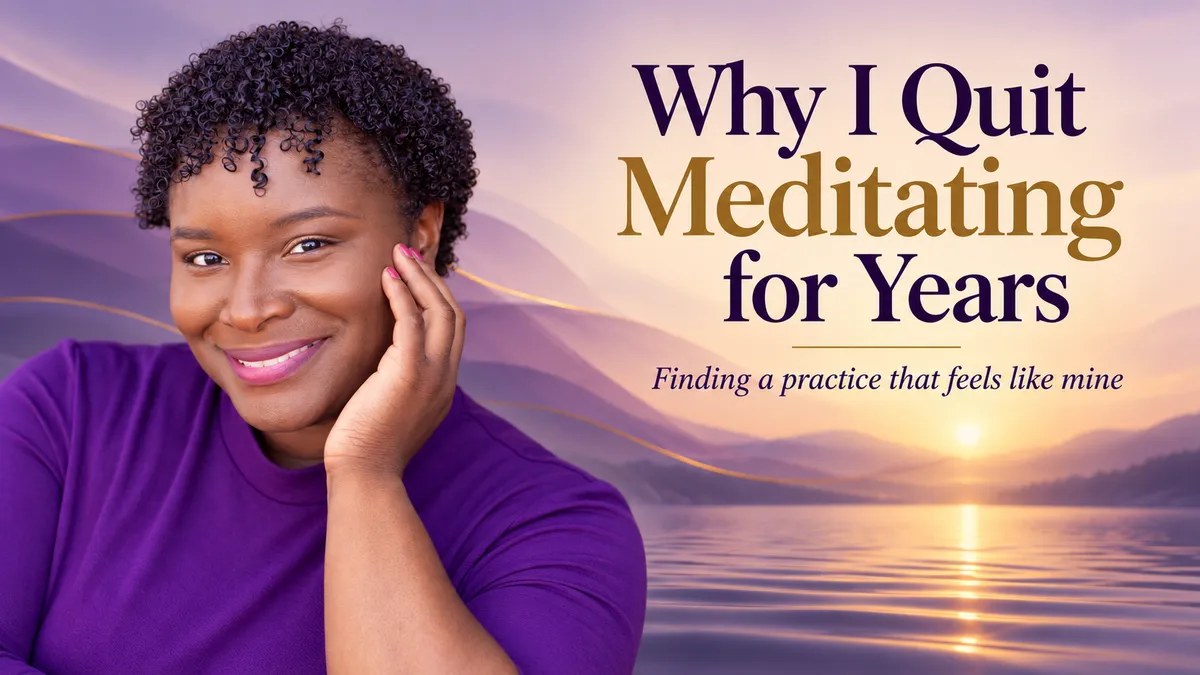
WHY I QUIT MEDITATING FOR YEARS
WHY I QUIT MEDITATING FOR YEARS
I felt unsuccessful when meditation asked me to picture things. Now I’m exploring ways to practice that feel more accessible.
“Close your eyes and picture a peaceful beach.”
For years, instructions like that made meditation feel like something I couldn’t do successfully. I would try to picture the scene, but it didn’t come easily. Instead of feeling calm, I started wondering whether I was missing something or doing it wrong.
Eventually, I quit meditating for years. I had come to associate the practice with feeling unsuccessful, and I didn’t want to keep repeating an experience that left me discouraged.
Now I’m trying again, with a different mindset. I’m exploring alternatives that don’t depend on seeing pictures in my mind. Visualization is one way to meditate, but it isn’t a requirement. I can use sound, breath, movement, touch, or words as an anchor. The practice can be about where I place my attention—not whether my mind produces a picture.
I THOUGHT I WAS FAILING AT MEDITATION
When visualization is presented as the main way to meditate, it’s easy to believe that not seeing a clear image means you’re bad at meditation. That belief can turn a quiet practice into a test: Am I seeing it? Is the picture clear enough? Why can other people do this and I can’t?
I’m learning that difficulty visualizing doesn’t mean I have failed. People experience mental imagery in different ways, and a meditation practice can be adapted to fit the person doing it.
NOT EVERYONE IMAGINES IN PICTURES
Mental imagery varies from person to person. Some people experience vivid inner scenes; others have faint or fleeting images, or think more naturally in words, sounds, sensations, or concepts. Some people have little or no voluntary visual imagery, often called aphantasia. That word describes an experience of mental imagery; it isn’t a measure of creativity, intelligence, or meditation skill.
Even if you can usually picture things, an image may not appear on demand. Stress, tiredness, distraction, or unfamiliar instructions can make visualization harder. And when you start checking every few seconds—“Am I seeing it? Is it clear enough?”—the exercise can become another task to get right.
You don’t have to force an image to appear. You can adapt the instruction or choose a different kind of meditation.
TRY AN ANCHOR YOU CAN ACTUALLY NOTICE
Breath: Notice the air moving at your nose, or the gentle rise and fall of your chest. There’s no need to take especially deep breaths or change your breathing. Let the sensation be enough.
Sound: Listen for one nearby sound, then notice sounds farther away. You might hear a fan, birds, traffic, or the quiet between sounds. There’s no need to label them as good or bad.
Body: In a body scan, move your attention from your feet upward. Notice contact, pressure, temperature, or tension. If a spot feels neutral or difficult to sense, move on. You don’t need to make up a sensation.
Words: Repeat a phrase that feels steadying, such as “I am here,” “One breath at a time,” or “May I meet this moment with care.” A mantra, prayer, or personal affirmation can be an anchor too, if it fits your practice.
Movement: If sitting still feels uncomfortable, try walking slowly or stretching gently. Notice your feet meeting the ground or the shift of your weight. You can bring your attention to the present while you move.
A TWO-MINUTE PRACTICE WITHOUT PICTURES
Sit, stand, or walk in a way that feels comfortable enough. Keep your eyes open or closed—choose what feels better. Pick one anchor: the breath, a sound, your feet on the floor, or a point of contact between your body and the chair.
For two minutes, notice that anchor. Your attention will probably wander. When you catch it, gently return. You don’t need to empty your mind, keep perfect focus, or visualize anything. Returning is part of the practice.
LET THE PRACTICE FIT YOU
You can change the language of a guided meditation. When you hear “picture,” try “think of,” “remember,” “describe,” or “notice.” You can leave your eyes open, pause the recording, or switch to a different practice. If turning inward feels uncomfortable, orient to the room instead: name a few things you see, feel your feet on the floor, and take a break if you need one.
Meditation isn’t measured by how vivid your inner pictures are. I’m asking myself: Is this practice helping me pay attention in a way that feels accessible and supportive? If visualization isn’t your path, there are plenty of other ways to be present.
I’m approaching this as an experiment, not a test I have to pass. I’m trying different ways to be present and noticing what feels accessible. If you’ve struggled with visualization too, what kind of meditation feels more natural to you? I’d love to hear what has helped.
Living Deeply Podcast with Markieta | livingdeeplypodcast.com
Thriven Humans Community with Markieta | thrivenhumans.org
It's Markieta Coaching Practice & Services | itsmarkieta.com